
You invested in a website. You waited. The phone didn’t ring.
It’s one of the most common things I hear from small business owners, and honestly, it’s one of the most frustrating. You did the right thing. You took the advice. You got the website. And then… nothing changed. So you start to wonder whether the whole thing was a waste of money, whether websites even work anymore, whether everyone else knows something you don’t.
They don’t. What’s happened is that you were sold half the picture.
A website is not your online presence. It’s the foundation of it. And a foundation, on its own, doesn’t do much.
The one place that’s truly yours
Here’s why a website still matters enormously, even if it’s not the whole story. Your website is the one corner of the internet you own and control. Social media platforms change their algorithms, reduce your reach without warning, and occasionally disappear or fall out of favour entirely (remember when every business had to be on Twitter?). Email providers update their spam filters. Google changes what it rewards. None of that can take your website away from you.
That’s why it comes first. Not because it’s the only thing you need, but because everything else points back to it. It’s the anchor. Without it, you’re building on rented land.
Five layers, five jobs
A complete online presence isn’t one thing. It’s five things, each with a distinct role:
- Your website is the home base. It tells your story on your terms, hosts your services and prices, captures enquiries, and builds trust before anyone picks up the phone.
- Hosting and technical health is the invisible layer. A slow website, a broken contact form, or a site that Google can’t read properly will quietly kill your results. The front-end means nothing if the back-end is broken.
- Search is how people find you when they don’t already know you exist. Someone in Brisbane types “florist for weddings near me” or “bookkeeper Redland Bay”. Whether your website appears in those results comes down to how well it’s set up for search.
- Social media is the amplifier. It builds awareness, keeps you visible between purchases, and lets people see the human behind the business. But it’s a top-of-funnel tool, not a closing tool. It starts relationships, it doesn’t seal them.
- Email and newsletters are the relationship builder. Once someone gives you their email address, you have a direct line to them that no algorithm can interrupt. It’s the warmest audience you’ll ever have.
Each layer has a job. Skip one and you’ve got a gap in the chain.
The Facebook-only trap
A lot of Brisbane small businesses run their entire presence through a Facebook page. I understand why. It’s free, it’s familiar, and your customers are probably already there. But there are things a Facebook page genuinely cannot do for you.
It won’t appear in Google when someone searches your business name and doesn’t already know you. It doesn’t give you a home for your full story, your portfolio, your pricing, or your terms. It can’t collect email addresses in any meaningful way. And if Facebook decides tomorrow to halve the reach of business pages (which it has done, repeatedly), you have no recourse.
Facebook is a tool that works best when it’s pointing people somewhere: your website, your booking page, your email list. On its own, it’s a cul-de-sac.
Your 24/7 team member
When your website is working properly, it answers questions at midnight. It builds trust with a potential client before they ever call you. It walks someone through your services when you’re in the middle of another job. It signals to Google that you’re a legitimate, established business worth recommending.
That’s a lot of work for one page. And it genuinely does all of that, but only when the other layers are feeding it. Without search visibility, no one finds it. Without social media, no one remembers it exists between visits. Without email, you have no way to stay in touch with people who weren’t ready to buy the first time.
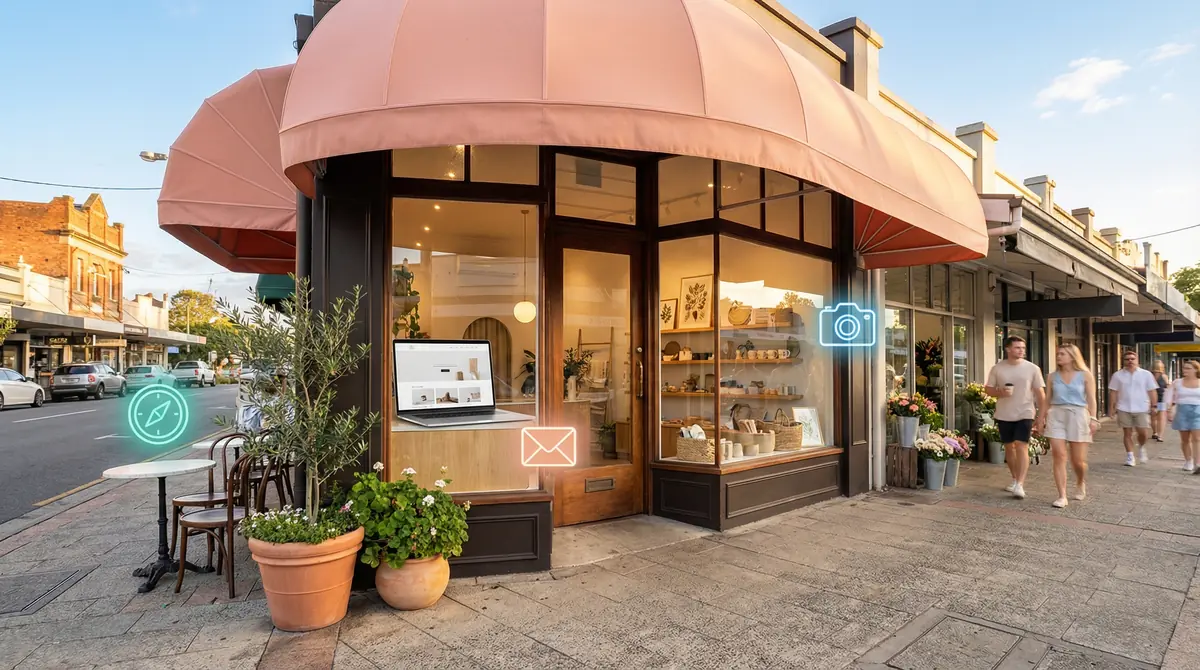
The website alone is like having the best shop front in Brisbane on a street no one walks down.
What “sorted” looks like in practice
This isn’t about doing everything at once. Most small businesses I work with start with the website and add layers over time. “Sorted” doesn’t mean perfect or complete. It means connected.
A sorted online presence has a website that loads fast, reads clearly on a phone, and has a working contact form. It has some basic search setup so Google knows you exist. It has at least one social channel where you show up regularly. And it has something, even a simple newsletter, that lets you collect and stay in touch with your audience.
That’s the map. Not complicated, not expensive if you approach it in stages, but clear.
The cost of disconnection
The thing that drains people isn’t the effort. Small business owners are some of the hardest-working people I know. It’s posting on Instagram and realising there’s no link to your website in the caption. It’s sending a newsletter from an email address with no sign-up form anywhere. It’s spending an hour on a Facebook post that gets seen by 40 people with no path to anything further.
The problem isn’t that you’re not trying. It’s that the pieces aren’t talking to each other.
Post two of this series goes into what search, social, and email each do for a small business and how to use them without losing your mind. Read part two here.
If this sounds like more than you want to manage alone, that’s exactly what I help Brisbane small businesses with. We can start with the website and build a clear plan from there. Let’s have a conversation.