You’ve done the hard work. You’ve built something real. Your service is good, your clients are happy, and you know your business inside out. Then someone asks you to send over your pitch deck, or you hand a prospect your brochure at a networking event, and something doesn’t land the way it should.
Most of the time, the problem isn’t the substance. It’s the document.
The default template problem
There’s a particular kind of slide deck I see constantly from small businesses. It starts with a stock PowerPoint template, the kind that ships with Office: dark blue header, white body, gradient background. The logo gets dropped in the corner. The text is everything you’d want to say, but it’s all there at once, in bullet points, in a font that feels off.
The content is good. The document says: this person threw this together.
I’m not being harsh. Most small business owners aren’t designers, and pulling together a deck the night before a client meeting is completely normal. The issue is that your materials are doing a job your business can’t afford to have them do badly. Whether it’s a pitch deck, a capability statement, or a printed brochure for a trade show, these documents are often the first thing someone studies closely before deciding whether to call you.
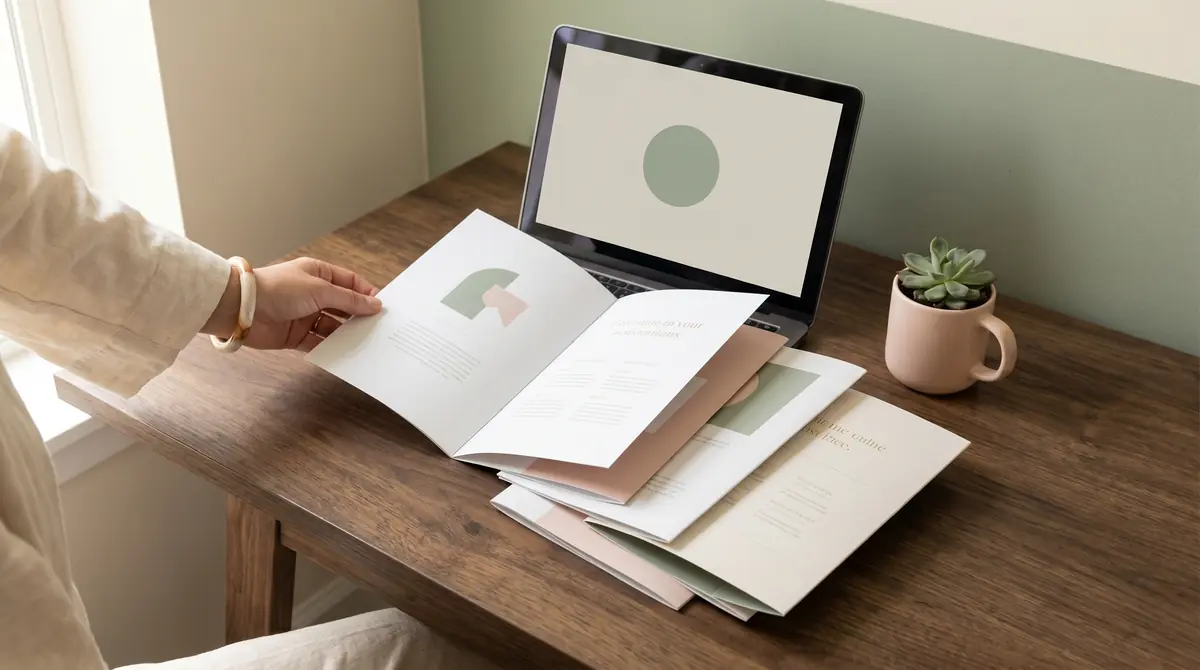
The same goes for brochures. A folded A4 from a word processor template, with clip art, a stock photo that has nothing to do with your business, and four different font sizes: that brochure is actively working against you. I’ve seen beautiful small businesses hand over something that looks like it was designed in 2003, and watch a warm lead go quiet.
What good design does differently
When I design a presentation or brochure, there are a handful of things I’m always thinking about.
Whitespace is doing real work. A slide that’s 60% empty feels confident. Cramming every piece of information onto one page feels anxious. Generous breathing room around your content signals to the reader that you’ve got control, that you’re not desperate to explain yourself all at once.
One idea per slide. This is the single most common mistake in pitch decks. Too much information competing for attention on the same page, and nothing lands. When a slide has one clear point, the reader absorbs it. When it has eight bullet points and three callout boxes, they read none of them and feel vaguely overwhelmed.
Typography that earns its authority. The font you choose, the size, the weight, the spacing between letters: all of it adds up to how the text feels to read. A well-chosen typeface feels like a confident voice. A poorly matched one feels like an email attachment.
Photography that earns its place. A stock photo of people shaking hands over a boardroom table adds nothing. A real photo from your workspace, or an image chosen because it communicates something specific about what you do, adds a lot.
And colour. Not many colours, used for everything. A restrained palette, two or three tones used deliberately, gives materials the kind of cohesion that makes a small business look like it has its design act together.
Brand consistency across everything
Here’s something that trips up a lot of businesses: your website looks one way, your PowerPoint looks another way, and your brochure looks like it came from a third business entirely.
Clients notice this. They won’t say “your brand is inconsistent,” but they feel a faint sense of uncertainty, a slight disconnection between the version of your business they see online and the version they hold in their hands. It reads as disorganised.
When your deck and your brochure feel like they came from the same place as your website, something clicks. You look like a business that takes itself seriously. That consistency alone can shift how a prospect reads everything else you put in front of them.
Brochures are not dead
I hear this occasionally from clients: “Does anyone even use printed brochures anymore?” Yes. Absolutely.
At trade shows, networking events, retail counters, in-person consultations, and client welcome packs, a well-designed printed brochure still does things a website can’t. You can hand it over. Someone can take it home and read it on their own time. It sits on a desk. It gets passed to a colleague.
The key word is “well-designed.” A badly designed brochure is worse than no brochure, because it actively communicates something you don’t want it to. A beautifully designed one, with considered layout, quality print, and real thought behind the content, is one of the best quiet sales tools a small business has.
I’ve watched clients hand over a new brochure for the first time and seen the person on the receiving end slow right down and look at it. That pause, that moment of “oh, this is nice” – that’s credibility shifting in real time.
A new service, and what it means for you
I’ve been doing a lot more of this work lately alongside my website projects, and I’ve decided to make it an official service. If you need a pitch deck redesigned, a capability deck built from scratch, a sales presentation that feels as professional as your website, or a printed or digital brochure for your business, I can help with that.
I’ll work from your existing brand if you have one, or we can build something together. The same care I bring to a website, the attention to layout, hierarchy, colour, and how everything fits together, goes into every page and every slide.
If you’re curious about what your marketing materials could look like, get in touch. I’d love to show you.