
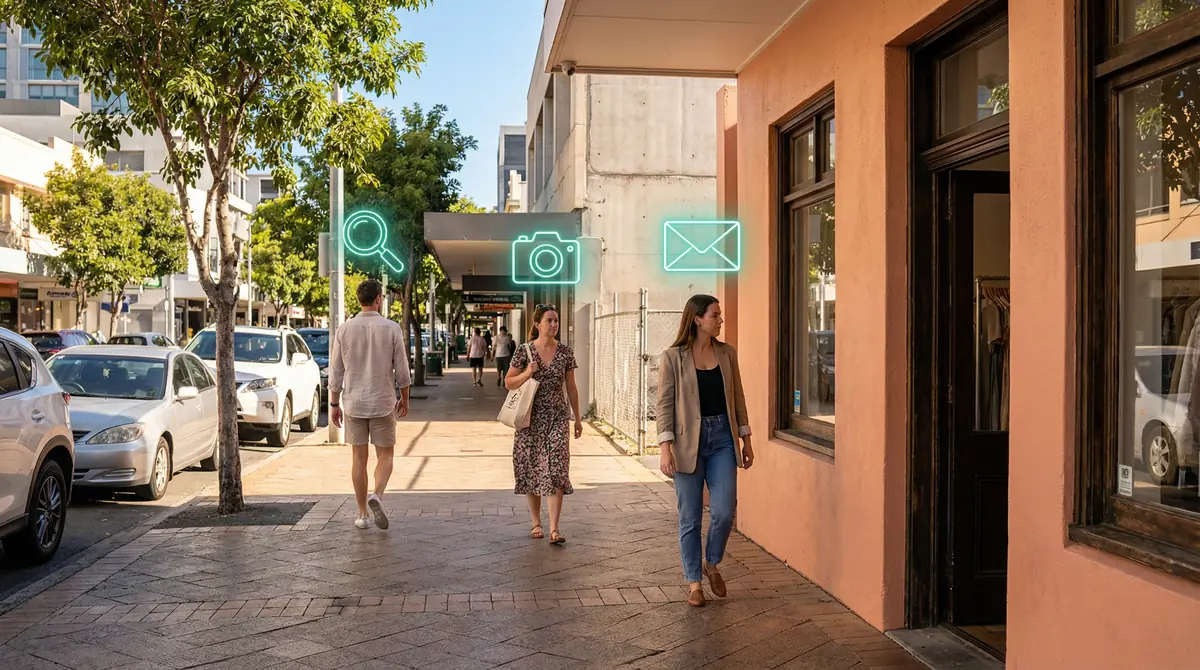
Last week I wrote about why your website is just the start of your online presence and the five layers that make up a complete digital picture. Today I want to go deeper on three of those layers: search, social, and email. Because most small business owners are doing at least one of these things, and few know why.
That’s not a criticism. Nobody told you what each channel is actually for.
Three channels, three genuinely different jobs
Search, social, and email are not interchangeable. They don’t do the same thing in different places. Each one reaches people at a completely different point in their relationship with your business.
Search gets you in front of strangers who are actively looking for what you do. Social keeps you visible to people who already know you exist. Email nurtures people who have told you, by subscribing, that they’re interested.
Once you see those as three separate jobs, you stop expecting Instagram to do what Google does. You stop wondering why your newsletter isn’t bringing in cold leads. Everything starts making more sense.
Building a system where all three channels work together is exactly the kind of thing I help Brisbane businesses set up from day one. If you want to know what that looks like, let’s have a chat.
Why search is the channel that matters most for local service businesses
When someone types “naturopath Brisbane Northside” or “wedding florist Redlands” into Google, they’re not browsing. They’ve made a decision to look for someone, and they’re ready to book. That’s different from any other channel. The intent is already there.
Showing up in those search results is called local SEO, and for a service-based business, it’s where I’d focus first if you could only do one thing.
The basics come down to a few things:
- Your Google Business Profile is the single most important free tool you have. If it’s incomplete, out of date, or not set up at all, you’re invisible in local searches. Fill it in properly: your hours, your services, your service area, photos, and your correct phone number.
- Consistent NAP (name, address, phone number) across every place your business appears online. If your address is listed differently on your website, your Google Business Profile, and a directory listing, Google’s confidence in your business drops.
- Keywords that match what real people type, not industry jargon. Your customers don’t search for “holistic wellness solutions”. They search for “acupuncture Brisbane” or “remedial massage Wynnum”. Write your website and profile content in the language your customers use.
Local SEO isn’t something you set up and forget, but it’s also not as complicated as it sounds. A well-built website with the right content and a complete Google Business Profile puts most small service businesses in a much stronger position than their competitors, because most competitors haven’t done it properly.
What social media is actually for
I want to be honest with you here, because a lot of social media advice quietly oversells what Instagram or Facebook can do for a small service business.
Social media does not reliably drive enquiries on its own for most of us. It can, and it does for some businesses, but if you’re posting three times a week and waiting for your DMs to fill up, you’ll exhaust yourself.
What social does brilliantly is maintain warmth and familiarity with people who already know you exist. The florist a customer used two years ago. The massage therapist someone followed after a friend mentioned them. The coach someone looked up after a podcast episode.
Those people aren’t ready to book right now. But when they are, you want to be the person they think of first. That’s what consistent, personality-driven social media does. It keeps you top of mind. It builds a sense of who you are and what working with you feels like. It shows proof through photos, reviews, and behind-the-scenes moments.
Posting without a clear purpose is exhausting. Posting with the right expectation is sustainable. If your expectation for Instagram is “stay warm and human with the people who already follow me”, you’ll approach it completely differently than if you expect it to bring in five new clients a month.
The email list you haven’t built yet
Email is the most underused channel I see with small service businesses, and it’s the one I’d push hardest for established businesses that already have some customers.
Your email list is the only channel where you own the audience. Instagram can change its algorithm overnight. Your Facebook reach can halve without warning. But an email list is yours. The people on it chose to be there, which means they’re more likely to read what you send, and they convert at a higher rate than cold social traffic for most service categories.
The basics don’t need to be complicated. A simple monthly newsletter, something like what’s new, what you’re working on, a tip or a story, is enough. What you need is a reason for people to subscribe: a free guide, a checklist, a discount for new clients. And a sign-up form that sits somewhere visible on your website.
That last part matters. Every channel eventually points back to the website.
The website is where it all lands
Google sends a searcher there. A social post links there. An email click lands there. The website is the destination for all of it, which is why a website that doesn’t convert wastes every bit of effort you put into the other channels.
If someone finds you on Google and your website is confusing, slow, or looks like it hasn’t been touched in five years, they’ll leave. If your email newsletter sends a subscriber to a landing page that doesn’t load properly on mobile, that click is gone. The website has to be ready to receive the people your other channels send its way.
This is what I talked about in Post 1 of this series: the website isn’t just one piece of the puzzle. It’s the anchor.
The small business reality check
You cannot do all of this at once, and you shouldn’t try. Here’s a more honest prioritisation:
If you’re a new business: get your Google Business Profile properly set up and build a website that works. That’s it. Those two things will do more for you than six months of social media posts.
If you’re an established business with existing clients and word-of-mouth referrals: email is your next best investment. You already have warm relationships. An email list keeps those people engaged and turns one-time clients into repeat business.
Social fills the gaps. It’s maintenance, not growth engine, for most small service businesses. Do it consistently and with personality, but don’t let it become a second job.
What’s coming in the next post
Understanding what each channel does is one thing. Putting it all together without it becoming overwhelming is another. In the next post in this series, I’ll explain how I help Brisbane businesses bring all of these pieces together from the start of a project, not as an add-on after the website is done.
Read Part 3: How I help Brisbane businesses manage their whole online presence without the overwhelm
If you want a partner who understands your whole online presence, not just your website, let’s talk. A discovery call is a good place to start, and there’s no pressure, just a conversation about where you’re at and where you want to be.